
How to Reduce Online Reading Distractions: 2026 Guide
In 2026, the average human attention span has plummeted to a mere 8.25 seconds, and most adults can only focus on a screen for 47 seconds before looking away. It's a frustrating reality when you're trying to stay productive. You likely recognize the feeling of your eyes skipping lines or that heavy mental fog that settles in after a short reading session. Learning how to afleidingen verminderen tijdens online lezen is no longer a luxury; it's a survival skill for the digital professional who needs to process information without the burnout.
We understand that digital eye strain and constant interruptions aren't a lack of willpower, but rather a result of a reading environment that hasn't evolved to meet your needs. This guide promises to help you eliminate those distractions and increase your reading speed by up to 35% by optimizing your typographical settings and cognitive focus. We'll walk through the essential steps to test your reading profile, reduce cognitive load, and build a personalized digital reading space that actually supports your brain's natural processing power.
Table of Contents
The Cognitive Science of Digital Distraction: Why We Struggle to Read Online
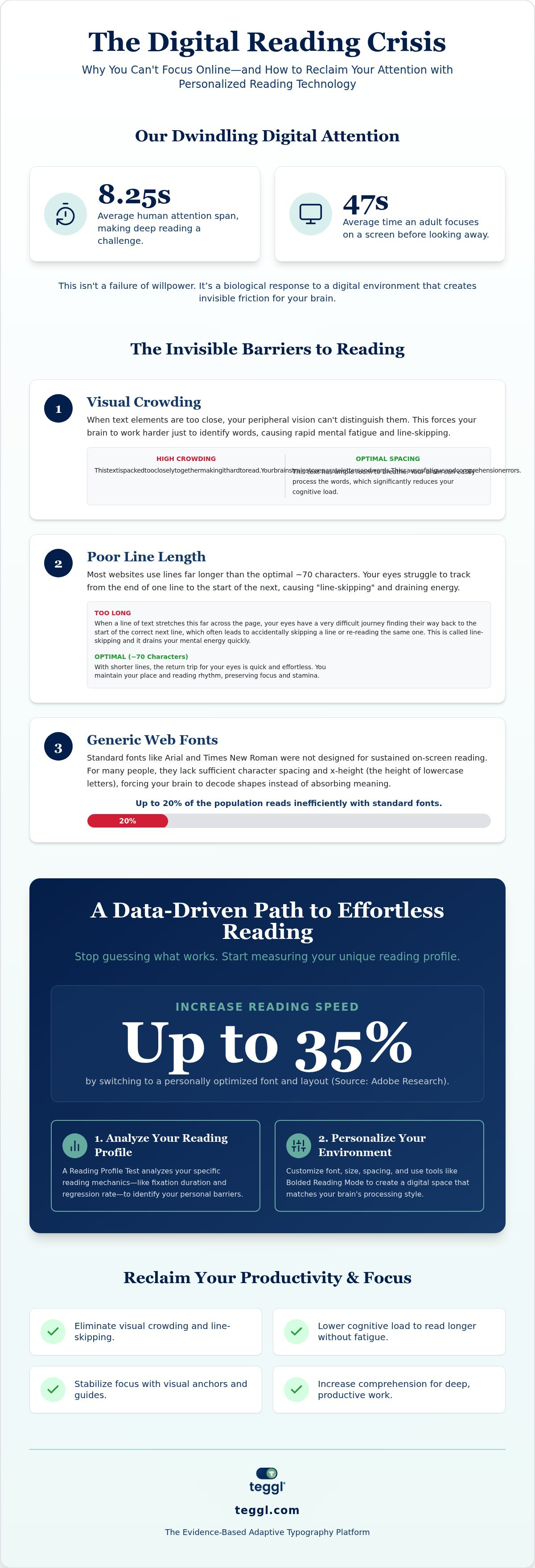
Most readers assume that losing focus is a personal failing or a lack of willpower. It's actually a biological response to poor digital design. Your brain frequently struggles with "Visual Crowding," a phenomenon where text elements are packed too closely for the peripheral vision to distinguish them clearly. This creates invisible friction within every paragraph, forcing your brain to work harder just to identify individual words. Understanding The Cognitive Science of Distraction helps us realize that the text itself is often the primary source of our struggle. By optimizing your typographical environment, you can effectively afleidingen verminderen tijdens online lezen and reclaim your concentration.
To better understand how these digital habits affect your brain, watch this helpful video:
Data from the University of Leeds suggests that the most efficient line length for reading is approximately 70 characters. When lines are too long, your eyes struggle to find the start of the next sentence, leading to "line-skipping." This unnecessary physical effort drains your mental energy. The key to sustained attention is reducing cognitive load while reading by creating a visual path that feels effortless and intuitive.
The Hidden Cost of Standard Web Fonts
Standard fonts like Arial were designed for general interface use, but they fail up to 20% of the population during deep reading sessions. These "one-size-fits-all" typographies often lack sufficient x-height, which is the height of lowercase letters, and proper character spacing. When letters are cramped, your brain spends extra energy decoding shapes rather than absorbing meaning. This is why you often feel exhausted after just ten minutes of reading a complex report; your eyes are performing a high-intensity workout they weren't designed for.
Visual Fatigue vs. Mental Focus
Eye-movement tracking studies reveal a high "regression rate" in digital readers. This is the act of constantly re-reading lines because your focus slipped or the text became a blur. It's a direct result of poor contrast and visual clutter. When you optimize your typography to afleidingen verminderen tijdens online lezen, you significantly reduce these regressions. This transformation allows you to move from passive skimming to active, high-performance reading that builds cognitive stamina over time.
The Online Reading Profile Test: A Data-Driven Approach to Focus
Stop guessing why your focus drifts and start measuring it. While generic speed tests only track how many words you can skim, a personalized online leesprofiel test analyzes the specific mechanical barriers between you and the text. This distinction is vital. Language proficiency is about what you know, but mechanical efficiency is about how your eyes and brain physically process pixels. Adobe Research has proven that individuals read up to 35% faster when they switch to their personally optimal font. By identifying your unique "sweet spot" for typography, you can effectively afleidingen verminderen tijdens online lezen and sustain deep concentration for longer periods.
True reading optimization focuses on two critical metrics: Effective Reading Speed (ERS) and fixation duration. Fixation duration is the millisecond-count your eyes rest on a word before moving to the next. High-performance reading requires shorter, more stable fixations. When your digital environment is mismatched to your profile, your fixations become erratic, leading to the mental fatigue discussed in the previous section. You can start optimizing your reading environment today to see immediate results in your daily workflow.
Finding Your Optimal Typographical Settings
Personalization is the only real solution to digital overload. A study from the University of Essex demonstrated that font weight and width significantly impact reading speed across different age groups. There is no such thing as a "perfect" font for everyone. The myth of a single dyslexia-friendly font has been replaced by the reality of individual customization. What works for a 25-year-old developer may not work for a 50-year-old executive. You must find the specific character spacing and thickness that stabilizes your visual field.
Assessing Your Digital Speed and Comprehension
Use a professional reading test for adults to establish your baseline. Speed is meaningless without retention, so aim for a threshold of at least 90% comprehension while you increase your words per minute. Integrating Self-regulated learning (SRL) strategies allows you to monitor your own cognitive states and adjust your settings in real-time. This data-driven approach ensures that you aren't just reading faster, but also understanding more with significantly less effort.
Actionable Solutions: How to Reduce Distractions and Personalize Your Reading
Take control of your digital environment now. A recent meta-analysis on digital reading distractions highlights how unoptimized text environments lead to significant comprehension losses. While generic reader modes simply strip away ads, they don't address the internal friction of the text itself. Implement these four steps to afleidingen verminderen tijdens online lezen and reclaim your focus:
Step 1: Conduct a diagnostic test to identify your specific visual triggers for distraction and line-skipping.
Step 2: Implement Bolded Reading Mode to create strong visual anchors that guide your eyes through dense paragraphs.
Step 3: Adjust your line spacing and x-height based on your specific results to eliminate visual crowding.
Step 4: Use a browser extension to apply these personalized settings automatically across every website you visit.
The Teggl Advantage: Bolded Reading and Real-Time Optimization
The Teggl Browser Extension transforms the chaotic web into a streamlined, high-performance environment. Unlike static tools, it uses Bolded Reading Mode to create "Bionic" anchors. These anchors emphasize the initial parts of words, allowing your eye to glide over the text without losing its place. This method effectively bypasses the brain's tendency to wander when faced with complex, uniform blocks of text. It's a sophisticated solution that turns any website into a tailored reading experience, ensuring your focus remains sharp from the first word to the last.
Long-Term Cognitive Benefits of Personalization
Optimizing your digital environment does more than just save time. It actively reduces the "end-of-day" mental fog caused by constant text overload. When your brain doesn't have to fight against poor typography, you preserve cognitive stamina for deeper analysis and creative problem-solving. This is essential for students, researchers, and knowledge workers who deal with heavy volumes of information daily. By choosing to afleidingen verminderen tijdens online lezen, you improve long-term retention and overall well-being.
Start your journey toward a focused digital life by taking the Reading Profile Test today.
Master Your Digital Focus and Reclaim Your Time
You now have the scientific blueprint to transform your reading habits from passive skimming to high-performance engagement. By addressing the root causes of visual crowding and identifying your specific typographical needs, you can reclaim hours of lost productivity every week. Research from Adobe and the University of Leeds confirms that personalizing your text environment isn't just a preference; it's a necessity for maintaining mental clarity in 2026. Taking these proactive steps allows you to effectively afleidingen verminderen tijdens online lezen while protecting your cognitive stamina for the tasks that matter most.
You can increase your reading speed by up to 35% and reduce cognitive load in real-time by simply adjusting how your browser displays information. Stop fighting against unoptimized screens that drain your energy. Instead, lean into a personalized approach that supports your brain's natural processing power. Take the Teggl Reading Profile Test & Optimize Your Browser today to start building a reading environment that works for you. It's time to experience the relief of clear, frictionless reading. You're ready to master the digital world with confidence.
Frequently Asked Questions
Can changing my font really reduce distractions while reading?
Yes, changing your font is one of the most effective ways to afleidingen verminderen tijdens online lezen. Research from Adobe and the Readability Consortium confirms that using a personally optimal font can increase reading speed by up to 35%. This simple adjustment lowers the cognitive effort required to process text, allowing your brain to focus on the meaning rather than the mechanics of decoding letters.
What is 'Visual Crowding' and how does it affect me?
Visual crowding occurs when text elements are packed too tightly for your brain to process them as individual characters or words. This "clutter" effect makes it difficult for your peripheral vision to distinguish the start and end of words, leading to frustrating line-skipping and constant re-reading. By optimizing spacing and font width, you remove these invisible barriers and stabilize your visual field for better concentration.
Is Bolded Reading effective for everyone?
Bolded Reading is highly effective for most readers because it creates strong visual anchors within the text. While it isn't a clinical treatment for ADHD or dyslexia, these anchors guide your eyes through complex paragraphs with much less effort. This technique is a practical way to afleidingen verminderen tijdens online lezen, as it significantly reduces the mental energy you'd otherwise spend just trying to keep your place on the page.
How do I find my personal reading profile?
You can identify your unique settings by taking a science-based Reading Profile Test. This diagnostic tool measures your performance across various typographical configurations to find the exact font weight, width, and spacing that works for your specific brain. Instead of relying on generic settings, you'll receive a data-driven profile that ensures your digital environment is perfectly aligned with your cognitive needs.
Comments